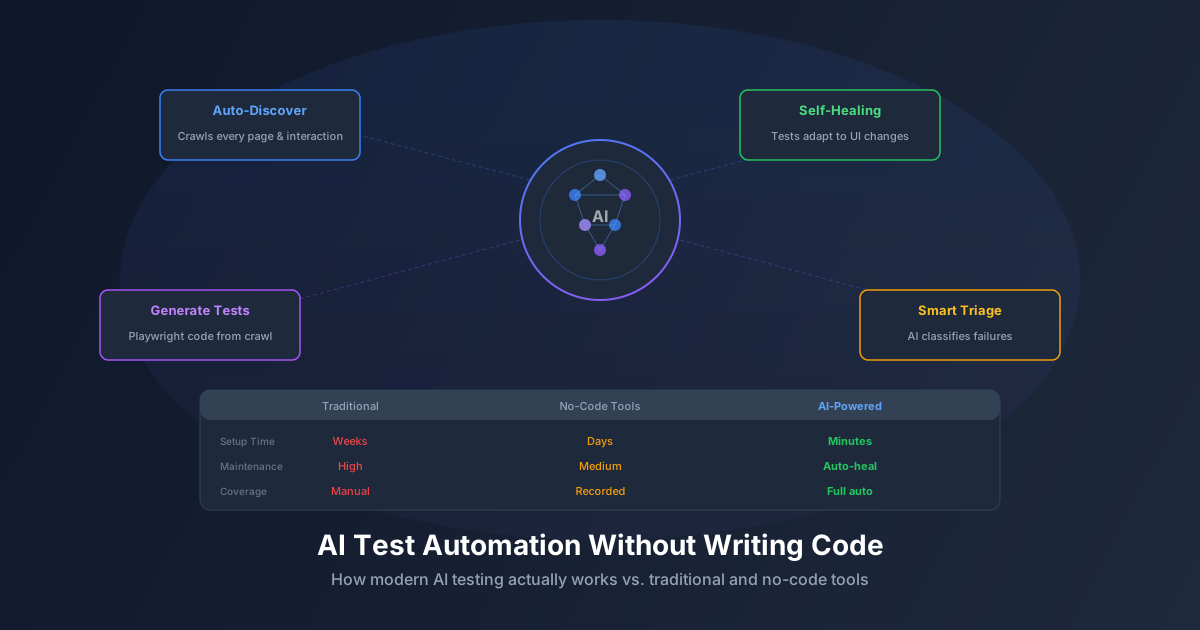
AI Test Automation Without Writing Code — How It Actually Works
No-code test automation promises a lot. Here's a technical breakdown of how AI test automation actually works, what the real tradeoffs are, and how AegisRunner compares to Mabl, Testim, and Cypress.
The promise of no-code test automation has been around for years. Record your actions, replay them, done. In practice, record-and-playback tools have a reputation for producing brittle tests that break constantly and require more maintenance than the code they were supposed to replace.
AI-powered test automation is different — not just in marketing, but in the underlying mechanism. This post explains what distinguishes genuine AI test automation from glorified record-and-playback, what tradeoffs exist, and how to evaluate tools honestly.
The Core Problem with Traditional No-Code Testing
Traditional codeless test automation tools record your interactions as a sequence of DOM events: click at coordinates (342, 217), type "hello" into field with id input_7a3f, assert text matches "Welcome back".
This approach fails for two reasons:
Fragility. DOM IDs and coordinates change constantly. A front-end refactor, a responsive layout change, a third-party widget update — any of these breaks recordings. Studies of large recorded test suites put maintenance cost at 40–60% of total QA effort.
No discovery. You have to record every test manually. The tool doesn't know anything about your application that you haven't explicitly shown it. Coverage is bounded by how much time your team spends recording.
AI test automation addresses both problems at the architecture level.
What Makes AI Test Automation Different
Crawl-Based Discovery
Instead of waiting for a human to demonstrate flows, an AI crawler explores the application autonomously. Starting from a URL, it:
- Renders the page in a real browser (Chromium, Firefox, or WebKit)
- Extracts all interactive elements — links, buttons, inputs, dropdowns, toggles
- Interacts with each element and observes what changes
- Follows navigation events to new pages and repeats
- Builds a complete graph of discovered states
This is not a sitemap crawl or a link scraper. It executes JavaScript, waits for async state, handles SPAs, and discovers states that don't exist in the static HTML — modal dialogs, expanded dropdowns, form validation states, loading skeletons.
Semantic Selector Generation
AI-generated tests use semantic selectors based on what elements mean, not where they happen to be in the DOM:
// Fragile — breaks when the CSS class changes
await page.locator('.btn-primary.checkout-submit').click();

// Semantic — survives refactors
await page.getByRole('button', { name: 'Complete Purchase' }).click();
The AI prioritizes ARIA roles, accessible names, labels, and data-testid attributes over structural selectors.
Self-Healing
When a selector fails, a self-healing system attempts to recover:
- If a role-based selector fails, try matching by visible text
- If text matching fails, try sibling elements of the same type
- If all alternatives fail, mark the test as needing human review
Self-healing handles the common case — UI refactors that change structure without changing meaning — automatically.
AegisRunner vs. Mabl vs. Testim vs. Cypress
Mabl
Cloud-based AI testing platform with proprietary test runner and visual editor.
Strengths: Polished UI, good visual regression, decent ML-powered auto-healing.
Weaknesses: Significant vendor lock-in — tests can't be exported as standard code. Pricing starts at ~$500/month. No local test execution outside Mabl's CLI.
Testim
Now part of Tricentis. Combines AI stabilization with record-and-playback.
Strengths: Fast to get started, Salesforce integration.
Weaknesses: Tests aren't human-readable code. AI stabilization is applied to recorded selectors, not rebuilt from semantic structure. Costs escalate at scale.
Cypress
Developer-first test framework, not an AI tool. Code-first by design.
Strengths: Excellent DX, real-time debugging, rich plugin ecosystem.
Weaknesses: No test generation — you write every test. No Safari/WebKit support. Parallel execution requires paid Cypress Cloud.
AegisRunner
Crawl-first, export-to-standard-code approach.
Strengths: No vendor lock-in (Playwright TS export), crawl-based discovery, built-in visual regression and accessibility testing, self-healing selectors, works with any web framework, free tier available starting at $9/month.
Weaknesses: Crawler-generated tests cover UI structure, not business logic. Complex auth flows require configuration. Newer platform.
Feature Comparison
| Feature | AegisRunner | Mabl | Testim | Cypress |
|---|---|---|---|---|
| No-code test creation | Yes (crawl) | Yes (record) | Yes (record) | No |
| Exports standard code | Yes (Playwright TS) | No | No | N/A |
| Multi-browser | Yes (3) | Yes (3) | Yes (2) | No WebKit |
| Visual regression | Built-in | Built-in | Add-on | Plugin |
| Accessibility testing | Built-in (axe-core) | No | No | Plugin |
| Self-healing | Yes | Yes | Yes | No |
| CI/CD integration | Yes | Yes | Yes | Yes |
| Pricing (entry) | Free / $9/mo | ~$500/mo | Custom | Free / $75/mo |
What "Codeless" Actually Means in Practice
"Codeless" does not mean "code-free forever." It means the test creation step doesn't require code. What you do instead:
- Configure a crawl: Provide a URL, authentication credentials if needed, and optionally scope the crawl
- Review discovered states: The crawler shows what it found. You decide which states matter
- Optionally customize exported tests: The output is Playwright TypeScript — you can add domain-specific assertions
This is genuinely different from writing tests from scratch. The cognitive load is reviewing and curating rather than authoring.
Limitations to Know Before Choosing
Complex conditional logic: If your app computes shipping from 12 variables, the crawler verifies a price appears — not that it's correct. That assertion needs a human.
Dynamic data dependencies: Tests depending on specific database state require test data setup — still engineering work.
Deeply nested SPAs: Most crawlers handle React Router and Vue Router well. Highly customized routing can confuse discovery.
Canvas and WebGL: Rendered graphics aren't inspectable as DOM. Visual regression catches changes, but interaction testing is limited.
The Right Mental Model
Think of AI test automation as a coverage floor, not a coverage ceiling. It gives you comprehensive regression coverage across all discoverable UI states with minimal engineering investment. On top of that, write targeted tests for business logic that matters most.
The broad base used to mean hundreds of hours writing unit tests. With crawl-based AI automation, it means configuring a crawl and reviewing the output.
Getting Started for Free
AegisRunner's free tier includes crawls of up to 50 pages, visual regression, accessibility audits, and Playwright TypeScript export. No credit card required.